
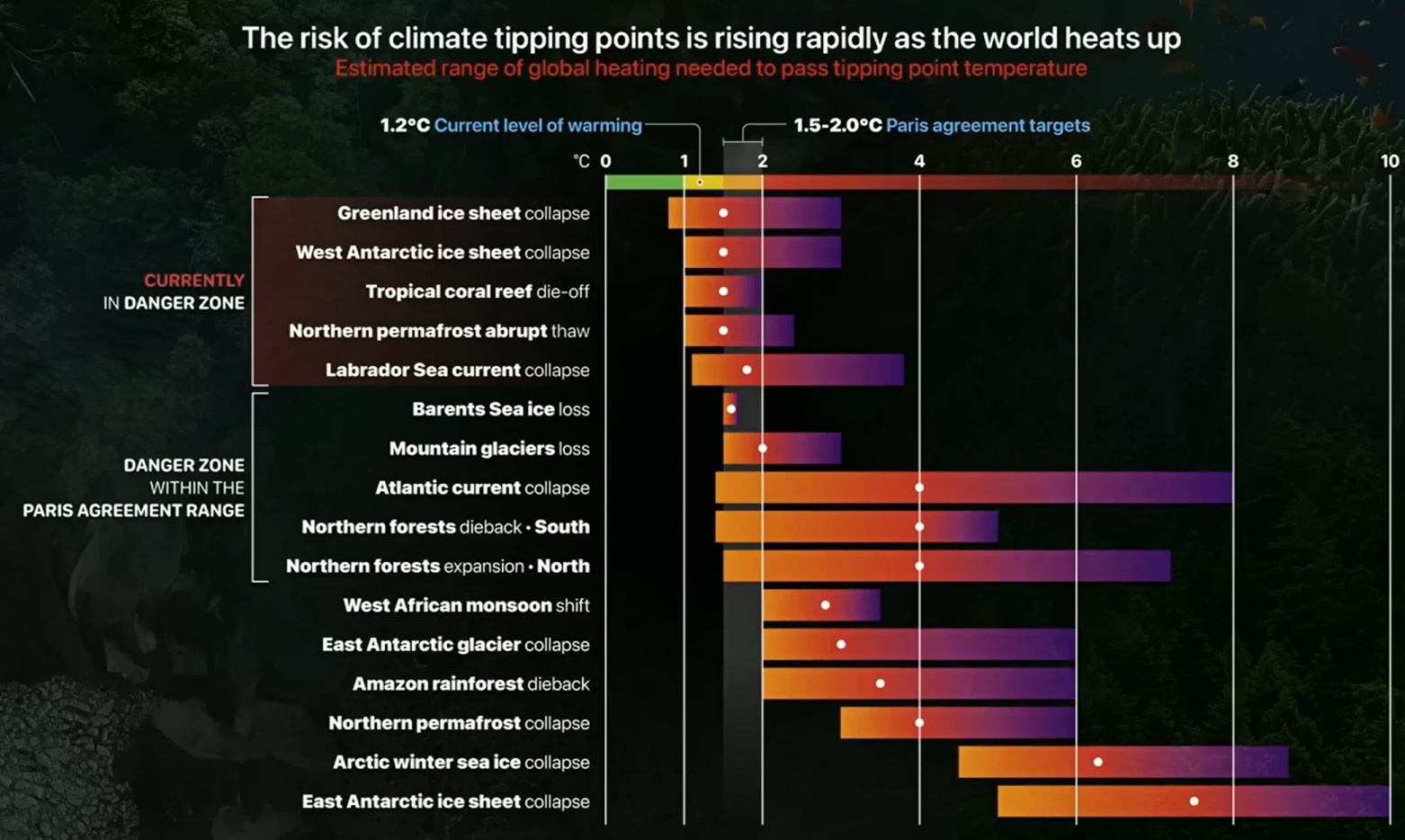
Tipping points are major Earth systems that upon reaching a certain threshold will cause irreversible, self-perpetuating changes. These changes include ecosystem collapse (i.e. the Amazon and the oceans coral reefs), catastrophic sea-level rises, and massive greenhouse gas releases from melting permafrost. Scientists have identified 16 major Climate Change tipping points (listed below). The first five of these tipping points are currently well within the danger zone of occurring if, or MUCH more likely, when the average global climate temperature rises to between 1.5°C and 2.0°C above pre Fossil Fuel Age levels.
The 16 climate tipping points:
- Greenland Ice Sheet (Collapse)
- West Antarctic Ice Sheet (Collapse)
- Tropical Coral Reef (Die-off)
- Northern Permafrost (Abrupt Thaw)
- Labrador Sea Current (Collapse).
- Barents Sea Ice (Loss)
- Mountain Glacier (Loss)
- Atlantic Current (Collapse)
- Northern Forest (die-back) South
- Northern Forest (expansion) North
- West African Monsoon (shift)
- East Antarctic Glacier (collapse)
- Amazon Rainforest (die-back)
- Northern Permafrost (collapse)
- Arctic Winter Sea Ice (collapse)
- East Antarctic Ice Sheet (collapse)
Temperature rise during the Fossil Fuel Age:
The average global temperature before the Fossil Fuel Age, the years 1850–1900, is widely estimated to be between 13.7°C and 13.8°C (56.7°F and 56.9°F). This pre-industrial, pre-Fossil Fuel Age, baseline period is used by the IPCC and WMO as the reference point for measuring global warming. Since 1850, the Earth has warmed by about 1.5°C (2.7°F). The rate of this warming has accelerated in the past 40 years – more than tripling since 1982. So while the average global temperature has always changed, it has never increased as much or as fast since we humans have been on earth.
Key details:
- Baseline: The 1850–1900 period represents the earliest period with reliable, instrumental, global station-based data.
- Baseline Value: Estimates range from 13.7°C and 13.8°C (56.7°F and 56.9°F).
- Temperature Rise: As of 2024, the global average temperature is roughly 1.5°C (2.7°F) above this pre-industrial, pre- Fossil Fuel Age baseline.
- Perspective: Do not think of this worming as 13.8°C (56.9°F) day compared a 14.3°C (59.6°F) day. Think of it as the difference between having a body temperature of 37°C and 38.33°C (98.6°F and 101.3°F). This seemingly small change in the global temperature will mean weird and catastrophic changes to our regional weather and triggering the above mentioned tipping points.
CO2:
- At the same time, CO2 has risen from 285ppm (parts per million) in 1850 to 430ppm today.